
Local sighting
A community begins the month based on a valid sighting within its locality or region. This gives weight to differing horizons and local religious authority.
Basis · Local testimony

MOON SIGHTING & THE HIJRI CALENDAR
A clear Sunni guide to crescent observation, astronomical calculation, local decisions, and why sincere Muslim communities may begin a month on different days.
Waxing Crescent · 17% illuminated
Approximate phase at October 15, 2026, 2:37 am CDT
This graphic shows an approximate astronomical phase, not whether the crescent is visible locally or whether a Hijri month has been confirmed.
Phase estimate uses a mean lunar cycle; it is intended as a visual guide, not a precise ephemeris.
The essential point: Future Hijri dates are predictions. Worship tied to the start of a month follows the determination adopted by the appropriate local community or recognized authority.
THE SUNNI FOUNDATION
The Islamic calendar is lunar. The Qur’an describes the moon’s phases as measures of time, and the Prophet ﷺ instructed Muslims to begin and end the Ramadan fast upon sighting the crescent. If visibility is obscured, the current month is completed as thirty days.
This Prophetic framework establishes actual crescent sighting as the basis for ritual month beginnings. Astronomical knowledge can help predict visibility, rule out impossible reports, and organize observation, while Sunni jurists differ over the extent to which calculation may independently establish a month.
There are two possible outcomes at the month boundary.
Follow the determination adopted by your community or recognized authority.
FROM CONJUNCTION TO VISIBILITY
The birth of the astronomical new moon and the first visible crescent are not the same event. Visibility depends on several interacting conditions.
01
The moon passes between Earth and the sun. The crescent is generally not visible at that instant.
02
Moon age, altitude, elongation, and the interval between sunset and moonset affect possible visibility.
03
Cloud, haze, dust, elevation, horizon clarity, eyesight, and optical aid can affect an observation.
04
A recognized authority assesses sighting reports according to its evidentiary and legal standards.
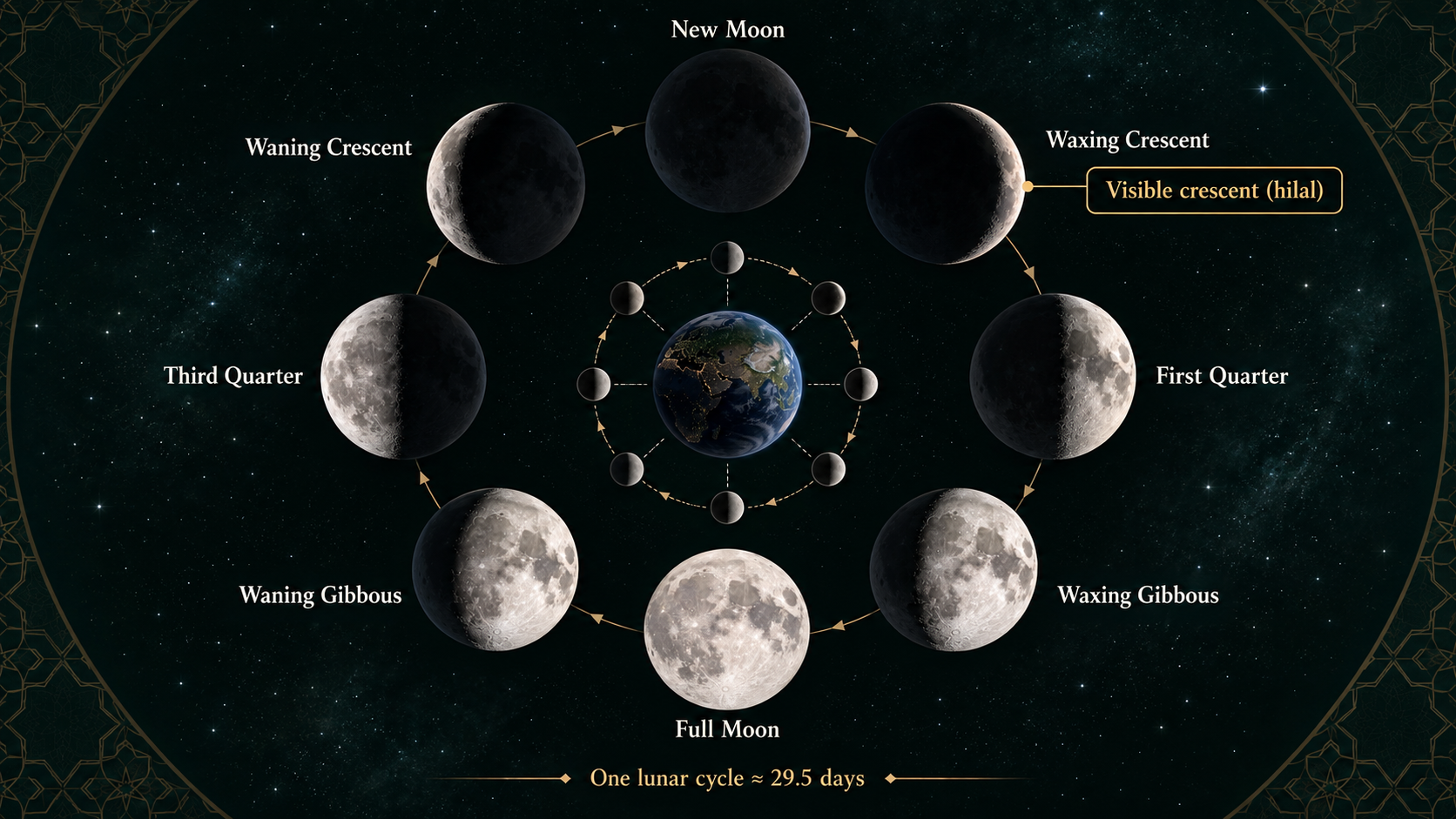
THE LUNAR CYCLE
The moon does not produce its own light. As it orbits Earth, we see changing portions of its sunlit half. These appearances are phases—not changes in the moon’s physical shape.
01
The astronomical new moon occurs when the moon is aligned near the sun. Its illuminated side faces away from Earth, so it is not the crescent observers seek.
02
The first waxing crescent may become visible after sunset once geometry and atmospheric conditions allow. Its visibility can vary by place.
03
The moon waxes toward fullness, then wanes. A complete phase cycle averages about 29.5 days, producing Hijri months of 29 or 30 days.
WHY DATES DIFFER
A community begins the month based on a valid sighting within its locality or region. This gives weight to differing horizons and local religious authority.
A verified sighting elsewhere is accepted for a wider area, sometimes internationally, subject to the adopted juristic view and authority.
Astronomical models estimate where a crescent could be seen. They can guide observers and help evaluate reports without necessarily replacing testimony.
Some organizations use predetermined criteria to establish dates. This offers consistency and planning, though Sunni scholars differ on its use for ritual beginnings.
LEGITIMATE DIFFERENCE
Differences can result from geography, weather, whether distant sightings are accepted, evidentiary standards, and juristic methodology. A one-day difference does not automatically prove carelessness or bad faith.
ISLAMCAL DATE LABELS
Every important date on IslamCal will identify its status so a forecast is never mistaken for a religious announcement.
An authority has formally established the date for the place or audience stated.
The date follows a named mathematical calendar or predetermined criterion.
A planning date that remains subject to the month’s actual determination.
A date established from a sighting or decision for a stated local community.
COMMON QUESTIONS
They may follow different authorities or juristic policies concerning local and distant sightings, calculations, or testimony.
A claimed new-month crescent before conjunction is astronomically impossible; experts and authorities may use this fact when assessing testimony.
No. IslamCal explains methods and reports date status. Religious announcements belong to the relevant recognized authorities.
Use this methodology alongside the month-by-month guide, where important dates and observances are clearly explained.
Choose the dates used by your community. Your selection also sets the calendar subscription links shown here.
You can change this anytime with the calendar button. Compare the calendars